Notice: Function wp_get_loading_optimization_attributes was called incorrectly. An image should not be lazy-loaded and marked as high priority at the same time. Please see Debugging in WordPress for more information. (This message was added in version 6.3.0.) in /home2/arellusc/public_html/website_9bebb230/wp-includes/functions.php on line 6260
Choose a water filter with more clarity.
A practical guide to checking filter claims and finding a system you’ll be comfortable using every day.

Before you start shopping
Filter specifications can blur together. Start with what you want to change about your water, then look for an exact model with evidence for that goal. Make sure the upkeep fits your routine.
Know what you want to change.
Check the source
For public water, start with your utility’s annual water quality report. For a private well, follow local testing guidance.
Name the goal
Better taste, lead reduction, and microplastics reduction are different goals. Taste and appearance alone do not establish safety.
Match the claim
Compare the exact contaminant claim with your concern. A filter’s shape or price does not answer that question.
Read the claim, not just the number.
NSF/ANSI standard numbers identify different standards; they are not a ranking. Certification does not mean every possible contaminant is reduced. NSF explains the distinctions.
Aesthetic claims, such as chlorine taste and odor.
Specific contaminant reduction claims related to health effects.
Reverse osmosis systems. Verify the particular reduction claims.
Emerging contaminant claims. Check which ones the model carries.
Look up the model and its replacement cartridge in the certifier’s current listing. “Tested to a standard” is a claim to investigate; it is not a substitute for checking a current certification listing.
For microplastics, ask a more specific question.
Some products have a Microplastics Reduction claim under NSF/ANSI 401. The NSF listing linked here shows the model, replacement element, and claim together. It is an example of what to verify, not a product recommendation.
Before you accept the claim
- Does the listing name the exact model and cartridge you will buy?
- Does it explicitly state microplastics reduction?
- What particle sizes and test conditions does the performance data sheet cover?
- What use and replacement instructions apply?
A result for a specified particle range does not, by itself, establish removal of every smaller particle or nanoplastic. Keep the conclusion within the scope of the documented test. A stainless steel exterior also does not establish that the complete water path is free of plastic.
What the documentation can show.
Certification claims apply to the exact model, cartridge, contaminant, and test conditions listed by the certifier.
Some current listings include microplastics reduction for a defined particle range. The claim should stay within that tested range.
Complete material details for the entire water path are often difficult to verify from public product information.
A certification result does not tell us the exact change in a household’s total everyday exposure.
A useful claim is specific. It names the model, the cartridge, what was reduced, and the conditions used for testing.
Choose a format you will use.
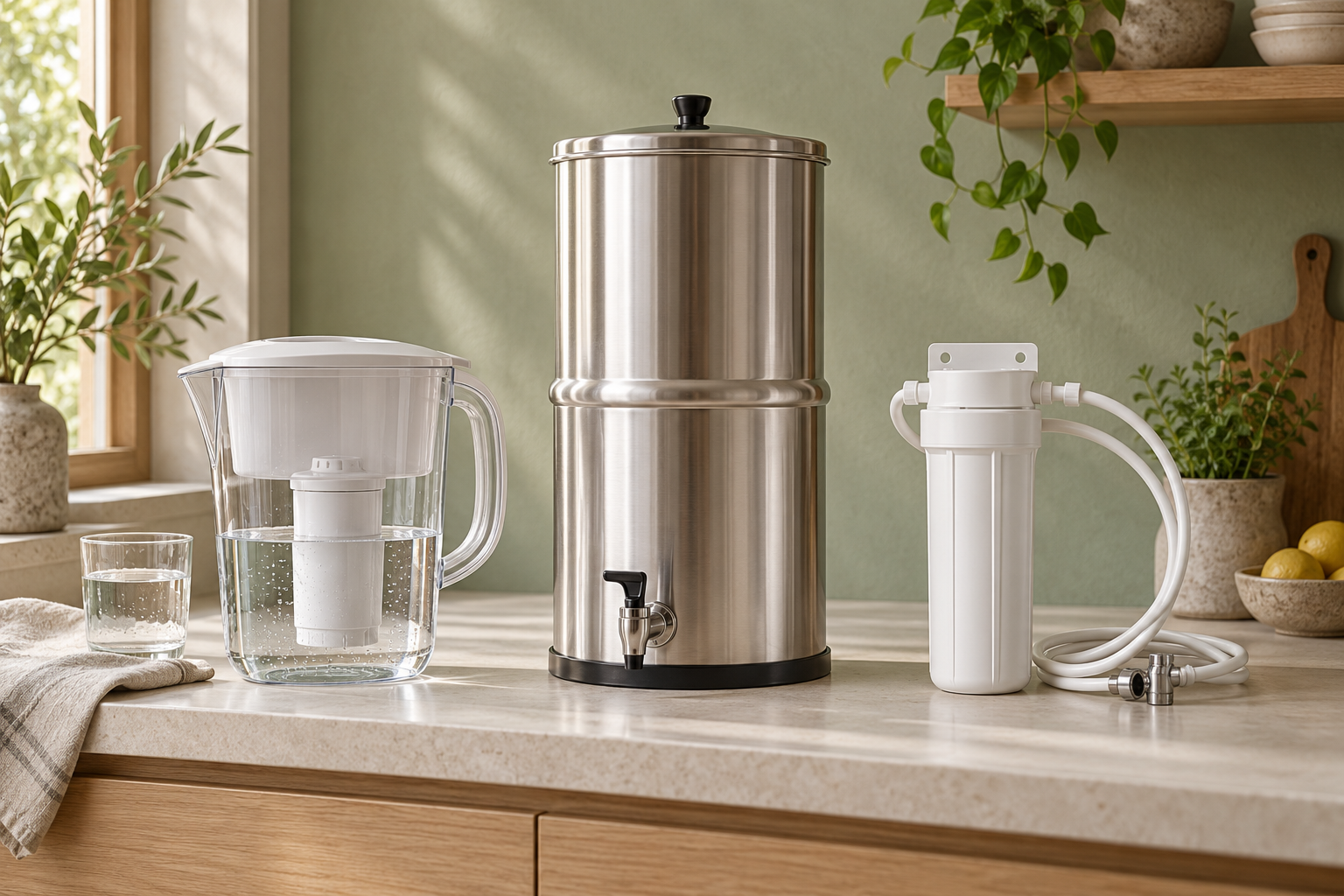
Pitcher or gravity
Ask how much water you need per refill, how long filtering takes, and how easily you can clean the reservoir. Check each model’s evidence.
Countertop
Measure the footprint and refill access. Ask whether it connects to a faucet, needs power, or uses a removable tank.
Under sink
Check cabinet space, plumbing requirements, access for cartridge changes, and whether installation needs professional help.
Reverse osmosis is a treatment technology, not a promise attached to one shape. It can appear in different system formats. Check its exact claims and operating requirements.
Follow everything the water touches.
A steel exterior tells you little about the tubing, seals, or reservoir inside. Ask the manufacturer which materials your water touches along the way.
Request material documentation for those parts. Mark missing information as unknown; do not convert a marketing phrase into a verified material claim.

The routine matters, too.
Follow the manufacturer’s cartridge replacement and cleaning instructions. CDC emphasizes maintenance to keep filters working and limit germ growth.
Before buying, write down replacement availability, cartridge cost, service intervals, and any installation or operating costs. A simple system you maintain may fit your life better than a complicated one you neglect.
Compare three filter formats
See how a pitcher, a countertop reverse osmosis system, and a gravity filter differ in our water filter comparison. We explain the documentation reviewed and the questions that remain.
Your buying checklist
Save these six details before making a decision:
- Your water source and goal.
- The exact model and replacement cartridge.
- The current certification listing and specific reduction claim.
- The relevant test limits and use instructions.
- Documented water contact materials. Note any details the manufacturer hasn’t provided.
- The maintenance routine and ongoing cost.
Have a claim or source that needs a closer look? Send us the documentation.
Sources & editorial notes
Sources checked October 10, 2026. This guide reviews documentation; Plastic Clarity has not performed laboratory or hands on filter testing for this article. Certification listings can change.
- CDC: About Choosing Home Water Filters: water assessment, model claims, and maintenance.
- NSF: Standards for Water Treatment Systems: what the standards address and why claims must be checked.
- NSF: example official NSF/ANSI 401 listing: specific to each model and cartridge microplastics reduction claims.
General educational information. Follow public health advice and your water supplier’s instructions during a water quality advisory; this guide is not a substitute for those instructions.
Learn how we assess sources in our Methodology. Read our Affiliate Disclosure. There are no affiliate purchase links or sponsored product placements in this guide.